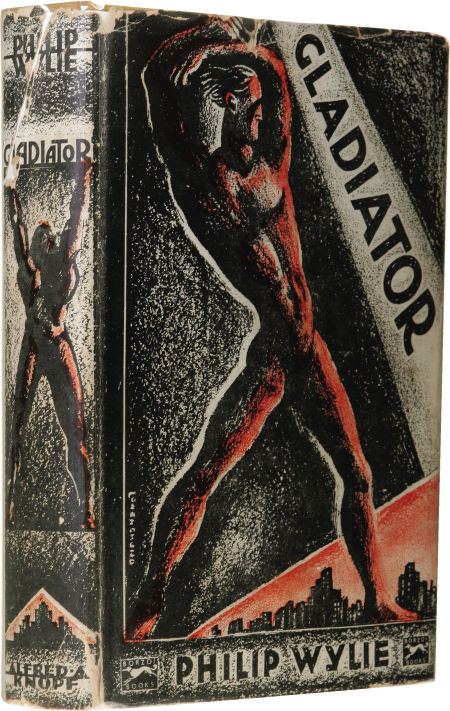
"When you were little more than a mass of plasm inside your mother, I put a medicine in her blood that I had discovered. That medicine changed you. It altered the structure of your bones and muscles and nerves and your blood. It made you into a different tissue from the weak fibre of ordinary people. Then—when you were born—you were strong. Did you ever watch an ant carry many times its weight? Or see a grasshopper jump fifty times its length? The insects have better muscles and nerves than we have. And I improved your body till it was relatively that strong. Can you understand that?"
"Sure. I'm like a man made out of iron instead of meat."
"That's it, Hugo. And, as you grow up, you've got to remember that. You're not an ordinary human being. When people find that out, they'll—they'll—"
"They'll hate me?"
"Because they fear you. So you see, you've got to be good and kind and considerate—to justify all that strength. Some day you'll find a use for it—a big, noble use—and then you can make it work and be proud of it. Until that day, you have to be humble like all the rest of us. You mustn't show off or do cheap tricks. Then you'd just be a clown. Wait your time, son, and you'll be glad of it. And—another thing—train your temper. You must never lose it. You can see what would happen if you did? Understand?"
"I guess I do. It's hard work—doin' all that."
"The stronger, the greater, you are, the harder life is for you. And you're the strongest of them all, Hugo."
...
...
Hugo went back to the deep forest to think things over and to become acquainted with his powers. At first, under full pressure of his sinews, he was clumsy and inaccurate. He learned deftness by trial and error. One day he found a huge pit in the tangled wilderness. It had been an open mine long years before. Sitting on its brink, staring into its pool of verdure, dreaming, he conceived a manner of entertainment suitable for his powers.
He jumped over its craggy edge and walked to its center. There he selected a high place, and with his hands he cleared away the growth that covered it. Next he laid the foundations of a fort, over which he was to watch the fastnesses for imaginary enemies. The foundations were made of boulders. Some he carried and some he rolled from the floor of the man-made canyon. By the end of the afternoon he had laid out a square wall of rock some three feet in height. On the next day he added to it until the four walls reached as high as he could stretch. He left space for one door and he made a single window. He roofed the walls with the trunks of trees and he erected a turret over the door.
For days the creation was his delight. After school he sped to it. Until dark he strained and struggled with bare rocks. When it was finished, it was an edifice that would have withstood artillery fire creditably. Then Hugo experimented with catapults, but he found no engine that could hurl the rocks he used for ammunition as far as his arms. He cached his treasures in his fortress—an old axe, the scabbard of a sword, tops and marbles, two cans of beans for emergency rations—and he made a flag of blue and white cloth for himself.
...
...
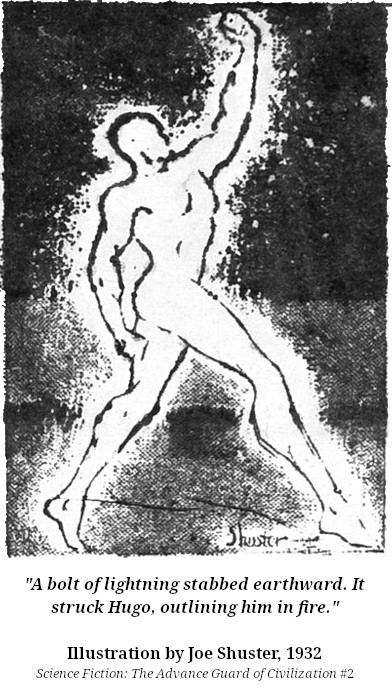
Jerry Siegel's review of Gladiator appeared in the second issue of Science Fiction: The Advance Guard of Civilization accompanied by at least one Joseph Shuster illustration (above).